Get Free Ebook Venice West, by John Arthur Maynard
You could favor to this publication since it is easy things to conquer. It indicates that the words as well as language to make use of in this Venice West, By John Arthur Maynard been available in simpleness. This prospective book will certainly help you easily to make far better concept of brand-new thought and upgraded information. When you actually want to get this publication, juts locate it in this site. We will certainly aid you to see the book link then get it as yours. This does not mean to overwhelm you to be in tight spot.
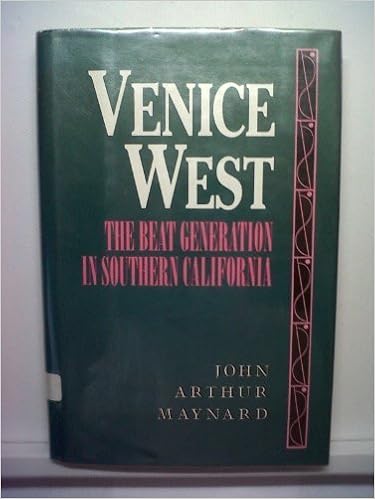
Venice West, by John Arthur Maynard

Get Free Ebook Venice West, by John Arthur Maynard
Don't you keep in mind about guide that constantly accompanies you in every leisure time? Do you till read it? Most likely, you will certainly need new source to take when you are bored with the previous publication. Currently, we will certainly provide once again the really magnificent book that is advised. The book is not the magic publication, but it can juggle something to be much bête. Guide is here, the Venice West, By John Arthur Maynard
Checking out is not for other individuals that obligate or order you to check out. The one that could enjoy and make use of the benefits of analysis is you. So, it is not type of worse when you are trying to be better by analysis. Even analysis will certainly not lead you to be effective 100%; this way can help you to meet the condition, lesson, experience, and also knowledge. Furthermore, this publication qualified Venice West, By John Arthur Maynard also becomes one that is really prominent.
And currently, after knowing the writer, you can also conquer that guide is advised to check out primarily form the factors. The here and now publication entitled Venice West, By John Arthur Maynard is done to manage you in obtaining more features of the lifestyle. You might not have to make different means of related sources to take place. When you have the various means to check out something, you could attempt to select the soft documents systems of this publication.
After establishing the communication of you in order to favor such book, you can directly discover as well as get to download as well as make deal with the Venice West, By John Arthur Maynard The source can be received from connect to provide here. As one of the best publication web site in the world, we always provide the most effective points. Obviously, guide that we offer always the book that provides amazing thing to learn and obtain. If you assume that you really need this publication now, get it as soon as possible.
From Library Journal
In the late 1950s, Venice was southern California's answer to Greenwich Village and North Beach. Maynard interweaves the bohemian colony's history with the lives of its two most prominent literary denizens: Stuart Perkoff and Lawrence Lipton. Perkoff, the quintessential beat poet, lived simply, took drugs, and was dedicated to his muse. Lipton, despite his rabid rejection of materialism, seemed doomed to become its victim. His book, The Holy Barbarians , brought a wave of publicity that all but drowned the real concerns of the beat movement, shifting the focus of attention from beats to beatniks. Maynard's book, begun as a dissertation, is meticulously researched and a pleasure to read. A major work on bohemianism, this is highly recommended.- William Gargan, Brooklyn Coll. Lib., CUNYCopyright 1991 Reed Business Information, Inc.
Read more
From Kirkus Reviews
Ponderously serious book about a California cult upheaval that prefigured the better-known rage of hippie bohemianism. Applying the full academic treatment, self-described historian Maynard, a Californian, delivers a defeating book that seems always to be promising a breakthrough for its beatnik subjects--and yet releases them only in death. There are some fast pages midway where the beatniks of Venice West attain a single season in the sun, but the public appetite for fads moves on, and the town goes into a long, lingering death rattle that cannot lift Maynard's literary sociology into brilliance and great humor. Venice was founded in 1905 ``as a genteel retreat for esthetically-minded Los Angeles businessmen'' and quickly became ``the Coney Island of the West.'' The ocean-front town was built in imitation of Venice, Italy, with a Grand Canal, Bridge of Sighs, miles of canals, and imported Venetian gondolas. It was much in decay by the late 1950's (Orson Welles used it as the vile bordertown in 1958's Touch of Evil), when Lawrence Lipton was readying his research on his fellow Venice bohemians, to be called The Holy Barbarians. Lipton--who seems to have been an oddly repulsive fellow--surrounded himself with callow, unformed poets, wanted to make a big statement of his opinions, and chose to ride his friends as a hobbyhorse for his breast-beating and tub-thumping. Alas for Lipton, the Kerouac/Ginsberg axis stole much of his thunder, and Venice West never achieved quite the recognition of Haight Ashbury. Despite some early ink in Life magazine and time on TV, which suddenly threw a hot spotlight on Venice, the town soon closed up as a beat enclave and its greatest literary lights (dim bulbs all) could not survive drugs, cancer, madness, or old age. What should have been a lively, eccentric book wilts under a pall of dreary sociology. -- Copyright ©1991, Kirkus Associates, LP. All rights reserved.
Read more
Product details
Hardcover: 242 pages
Publisher: Rutgers University Press; First Edition edition (April 1, 1991)
Language: English
ISBN-10: 0813516536
ISBN-13: 978-0813516530
Product Dimensions:
6.5 x 1 x 9.5 inches
Shipping Weight: 15.2 ounces
Average Customer Review:
4.2 out of 5 stars
8 customer reviews
Amazon Best Sellers Rank:
#988,670 in Books (See Top 100 in Books)
Interesting book for those interested in the beat generation.
A readable history of the Beat movement as it existed in Venice CA. The main characters are featured with a lot of supporting detail.
I thought this would focus on the neighborhood during the Beat era. Instead, it mostly talks about the people there, focusing on two in particular. Neither of them I found interesting enough to build a book around. If you're interested in learning about some of the residents there during this period you can take a chance. If you're more interested in Venice itself, I'd give it a pass.
John Arthur Maynard's book on the bohemians of Venice, CA in the 1950s is one of the most unique tomes in Beat Generation non-fiction lore. Maynard got all of the gritty details on a community of self-taught artists that were disillusioned enough with the "good life" to see past their own creative limitations, and to carve out an existence built on earnest self-discovery. Those guys found that living and expressing was almost microbiotic to being alive. I really admire what Maynard did here... not sure if people give him enough credit for this book. It lays out just how intense Venice was, because before, after and in spite of any promotional "beatnik" shuck, they lived a true nomadic lifestyle. Unlike the bohemians of Left Banke Paris or even the deified beats of Greenwich Village/North Beach, the men and women of Maynard's book are all the more powerful because of their lack of pretense.In Greater Los Angeles, the beach town of Venice saw the most intense conglomerate of writers later dubbed "beatniks," who in reality despised the label. Venice was simply a cheap place to live out of the spotlight, with a long history of seediness and urban decay. At this edge of land's end, a small group of self-taught poets and artists experimented with art, drugs and their own survival in a way that was never flashy, while the results were more harrowing than most want to realize. This is what makes John Arthur Maynard's book so powerful to read.
As a girl who grew up in Venice, this was a fascinating read to explore more of the town I know so well. A colorful account of what that era in that unique place was like. Reading this, I got to see my old neighborhood in a new light.
"Here, down in Venice West, we have a new kind of beat, the real beat, the Beat Generation of the Future. I have called them by their true title, 'The Holy Barbarians,' and the report I have just finished making about them will be called by that name," said Lawrence Lipton to a British reporter. John Arthur Maynard, in his study of the Venice West beat community, writes of Lipton's 1959 book: "Its photo essay, verbatim conversations with 'real beatniks,' and handy glossary of hip jargon, made it a kind of do-it-yourself guide to the Beat Generation." It also provided thousands of Americans with an image of the Beats. And when Time, Life, Look, or ABC News wanted to do a beatnik story, they usually headed not for Greenwich Village, or the North Beach of San Francisco, but to Venice West in Los Angeles. Maynard's study of the Venice West bohemians (who didn't think of themselves as Beats) is a fascinating study of the people who created many of our perceptions of what Life's Paul O'Neil called "The Only Rebellion Around." The Venice community, writes Maynard, consisted of only two dozen or so writers and artists, of whom only one, poet Stuart Perkoff, was truly original. Lipton, says Maynard, tried to make the Venice Beats in his own image--his "holy barbarians" who will storm the gates of civilization "not with the weapons of war but with the songs and ikons of peace." Maynard provides brief biographies of the Venice West principals, including Lipton and Perkoff, and details the saga of the Venice West Cafe' Expresso (sic), where Perkoff had painted "Art is Love Is God" on the back wall. The last chapters chronicle the decline of the Venice West bohemian community in the 1960s and into the 70s. Most scholarly studies of the Beats focus on Kerouac, Ginsberg, and Burroughs--three very original writers. But they were perhaps too original for the news media of the 1950s. To understand America's perception of the Beats, we need to go to Venice West. John Maynard has allowed us to do just that.
I'm half-way through Venice West and find it informative and refreshingly insightful without the sycophantic sanctification of some popular fare. Maynard balance an arguably difficult subject well, walking the tightrope between readable sound scholarship without plummetting the reader into a minefield littered with puddles of self-indulgent philosophical academic mental-masturbation. Another reviewer (a former student of Maynard), took issue with a Kirkus review of this book, and I agree. I don't recognize any of Kirkus' conclusions about Venice West. Reading it makes me feel like I do when having an enjoyable and gossip-free conversation with an intelligent friend. I've noted names unfamiliar to me which will serve as waypoints for further exploring my curiosity of the topic. I've read a few accessible books about 'Beat', and Venice West fills a mostly unacknowledged void that is noteworthy, historically and culturally relevant to 'Beat', and Maynard fulfills this task well. I highly recommend Venice West for anyone interested this social history.
Venice West, by John Arthur Maynard PDF
Venice West, by John Arthur Maynard EPub
Venice West, by John Arthur Maynard Doc
Venice West, by John Arthur Maynard iBooks
Venice West, by John Arthur Maynard rtf
Venice West, by John Arthur Maynard Mobipocket
Venice West, by John Arthur Maynard Kindle

Tidak ada komentar:
Posting Komentar